


Solid Ground is now offering FORTIFIED Evaluations
Solid Ground Home Inspections is now officially offering FORTIFIED Roof™ inspections, bringing Charleston‑area homeowners a nationally recognized resilience standard backed by the Insurance Institute for Business & Home Safety (IBHS).
Stephen Houmard, owner and lead inspector at Solid Ground Home Inspections, is now a Certified FORTIFIED Roof™ Evaluator, trained to verify that a home’s roof meets every requirement of the national FORTIFIED standard. This certification means Stephen can perform the official evaluation, documentation, and verification needed for homeowners to earn a FORTIFIED designation—something only credentialed evaluators are authorized to complete. His certification allows Solid Ground to guide homeowners through the entire process, from identifying upgrade needs to confirming compliance with IBHS standards.
Stephen Houmard
Certified FORTIFIED Roof Evaluator
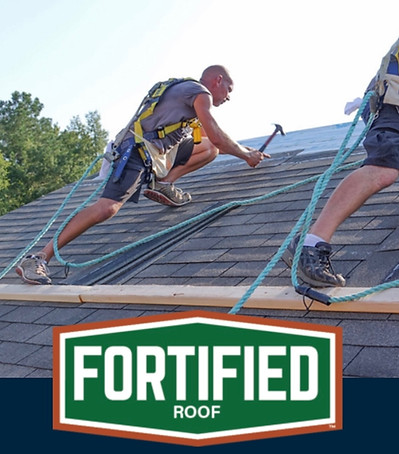
All About FORTIFIED
Homeowners across the country are turning to FORTIFIED construction standards to strengthen their homes against severe weather. Whether building a new home, replacing a roof, or renovating an existing structure, the FORTIFIED program offers an affordable, science‑backed way to increase resilience. These standards are designed to reduce the risk of storm‑related damage by improving the durability of the building’s most vulnerable components—especially the roof, which is often the first point of failure during hurricanes, high winds, and heavy rain.
Developed by the Insurance Institute for Business & Home Safety (IBHS), FORTIFIED is built on more than 20 years of research, real‑world testing, and post‑storm field observations. IBHS offers tailored standards for both coastal and inland construction, each focused on the specific weather threats a home may face, including hurricanes, hail, straight‑line winds, and low‑level tornadoes. By following these guidelines, homeowners gain a measurable increase in protection and often qualify for insurance incentives that reward resilience.
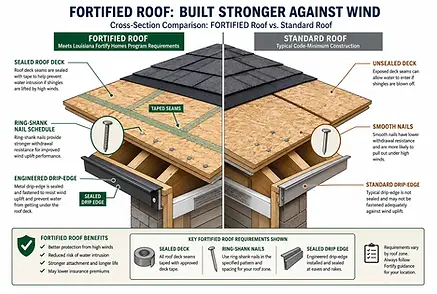
A FORTIFIED Roof is engineered to perform far beyond a typical roof installation. It incorporates enhanced materials and installation methods—such as sealed roof decking, ring‑shank nails, reinforced roof edges, wind‑rated roof coverings, and upgraded attic vents—to prevent the cascading damage that begins when roof coverings fail. These improvements help keep water out, reduce uplift during storms, and maintain the structural integrity of the home. Together, they create a stronger, more reliable roof system designed to withstand the severe wind, rain, and pressure common in coastal environments like Charleston.
-
Stronger roof edges — Wider drip edges and fully adhered starter strips prevent wind from getting under shingles and tearing them away.
-
Sealed roof deck — If shingles blow off, a sealed deck can reduce water intrusion by up to 95%, preventing catastrophic interior damage.
-
Enhanced attachment — Ring‑shank nails nearly double the uplift resistance of the roof deck compared to standard smooth nails.
-
Impact‑rated roof covers — Optional hail supplements ensure shingles or metal panels meet strict impact standards for hail up to 2 inches.
-
Wind‑ and rain‑resistant attic vents — Prevent wind‑driven rain from entering through typical vent openings.
-
Protection for windows, doors, garage doors, soffits, and attached structures — In hurricane‑prone areas, these upgrades prevent pressure changes that can collapse walls or roofs.
A FORTIFIED Roof inspection provides several major benefits for Charleston and coastal Lowcountry homeowners:

For homeowners, a FORTIFIED Roof inspection can lead to insurance savings, increased home value, greater storm resilience, and peace of mind knowing the roof meets the highest national standard for severe‑weather protection. Solid Ground Home Inspections now provides full FORTIFIED evaluation services—helping Charleston families strengthen their homes before the next storm season.

Watch this quick video to understand the role of a
Certified FORTIFIED Roof Evaluator and the full range of
advantages that FORTIFIED offers to home buyers.
FAQ - Fortified Home Program
What is a FORTIFIED Home?
A Fortified Home is a residential property built or retrofitted to stronger, storm-resistant building standards developed by the Insurance Institute for Business & Home Safety (IBHS).
The Fortified Home program goes beyond standard building codes to reduce damage from severe weather such as hurricanes, high winds, hail, and tornadoes.
How does the FORTIFIED Home Program Work?
The Fortified Home program uses specific construction and re-roofing standards that focus on vulnerable areas of a home — starting with the roof and extending to windows, doors, and structural connections.
A certified Fortified Evaluator documents and verifies that the home meets all applicable standards before a Fortified Home designation is awarded.
What are the different levels of FORTIFIED Home Certification?
FORTIFIED Home Certification levels:
-
Fortified Roof – Strengthens the roof system to keep water out and resist wind damage.
-
Fortified Silver – Adds protection for openings like windows and doors, and attached structures.
-
Fortified Gold – Provides the highest level of protection by connecting the entire structure into a continuous load path.
Can I make my existing house a FORTIFED Home?
Yes. Most existing homes can be upgraded to meet Fortified Home standards, particularly at the Fortified Roof or Fortified Silver levels. Even homes being re-roofed can often integrate Fortified upgrades during that process.
Are there financial benefits to having a FORTIFIED Home?
Yes. Because a Fortified Home is scientifically proven to perform better against severe weather, many insurance companies offer premium discounts or endorsements for certified homes. These incentives vary by insurer and state, so homeowners should consult their agent for specific details.
Does a FORTIFIED Home Certification increase property value?
Homes with Fortified Home certification can have higher resale value because buyers recognize the added resilience and potential insurance savings. Some studies indicate an increase in appraised value compared to non-Fortified homes.
Ready to upgrade your home? If you’re renovating, re-roofing, or building new, consider these upgrades to make your home stronger against hurricanes. Upgrade now and be Hurricane Ready!
1. Strengthen your roof against severe weather.
-
Replace your roof with a FORTIFIED Roof that is designed to prevent wind and water damage with just a few additional methods and materials. Decades of IBHS research have gone into developing this roofing standard that can help keep your roof on and water out during severe weather. Here’s how a FORTIFIED Roof works:
-
Better roof deck attachment using ring-shank nails in an enhanced nailing pattern helps keep the roof deck attached to your home.
-
Stronger roof edges reinforce your roof where it is most vulnerable to uplift during powerful winds.
-
A sealed roof deck keeps rain from seeping through the cracks of the roof deck boards even when your roof cover is lifted or blown off.
-
Impact-resistant skylights to withstand water intrusion and large impacts.
-
Find a professional to install a FORTIFIED Roof. This process includes an intensive inspection by an independent, third-party evaluator so you can be confident it meets the requirements shown to reduce storm damage.
-
Having a designated FORTIFIED Roof may qualify you for an insurance discount so be sure to ask your insurance agent for available incentives!
-
2) Upgrade to a wind-rated garage door.
-
Check for a wind rating label on your garage door. While modern building codes require garage doors to be wind-rated, without a label, it’s difficult to know which doors are rated and which aren’t. Additionally, prior to 2006, there were no requirements for wind-rated doors for homes built outside of Florida, and even today, some areas have not yet adopted a modern building code with a garage door requirement.
-
Look for a label inside the garage door that shows it’s rated for wind pressures in positive and negative PSF (pounds per square foot) values. Wind-rated garage doors labeled with PSF values have been tested to withstand wind pressures.
-
If there is no label or the current label is missing this information, it may not be wind-rated, and it is best to purchase a new garage door.
-
Purchase a wind-rated garage door.
-
Consult your local building code department or a local garage door dealer to find out the wind rating required for garage doors in your area.
-
Look for doors tested to one of these standards:
-
ASTM E330
-
ANSI/DASMA 108
-
Florida Building Code TAS 202
-
Once the garage door is installed, ensure it shows a label with the wind rating. Remember, don’t peel off the label!
-
-
3) Upgrade to impact-rated windows & doors with glass.
-
Purchase windows and doors with glass labeled as impact resistant.
-
4) Purchase hurricane shutters.
-
Purchase hurricane shutters (code-conforming aluminum paneling) to cover your windows before an approaching hurricane.
-
Note: Plywood should only be used in place of shutters as a last-minute resort when tropical weather is imminent. If plywood must be used, be sure it’s at least ¾ inch thick. Additionally, taping windows provides no protection and should NOT be used.
-
5) Invest in a whole-home generator.
-
Purchase a whole–home generator to keep your power on.
-
Want a stronger house?
-
When building (or re-building) a new home, enhance its structural integrity with FORTIFIED Gold, a beyond code construction method developed based on decades of IBHS research. It includes a stronger roof and garage doors, anchored carports and porches, and reinforced chimneys and gable-ends to help keep your home intact during a severe weather event. The standard also requires an engineered continuous load path, which is a plan that specifies how your roof should be connected to your walls and how the walls should be anchored to the foundation. Having a FORTIFIED designation may qualify you for an insurance discount, too!